
Creative Direction
One Idea, Many Outputs
A practical way to make film, design, motion, and digital touchpoints feel like parts of one story—not separate requests sharing a deadline.
- Written by
- AY Media Work
- Published
- Reading time
- 4 minute read
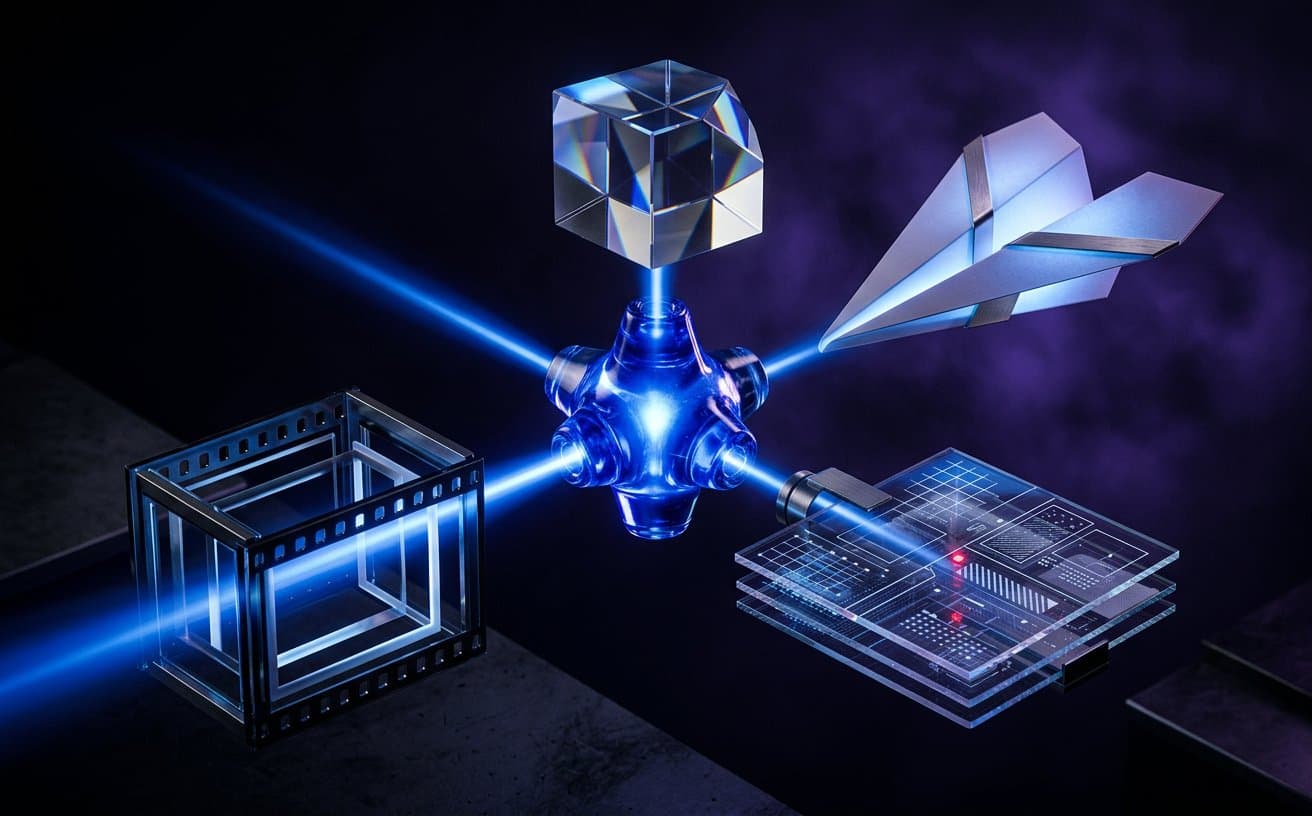 Original Studio Journal artwork
A project can begin as a film and quickly become a landing page, a set of social cutdowns, campaign graphics, motion loops, and a product explanation. The number of outputs grows, but the audience should still feel one clear thought moving through all of them.
That coherence does not come from placing the same colour and logo everywhere. It comes from deciding what must remain recognisable when the format, pace, and level of detail change.
Start with the idea that must survive
Before discussing deliverables, write the central idea in language that can guide a creative decision. It should be more useful than a slogan and more focused than a list of objectives.
A working idea might describe a tension to resolve, a change the audience should understand, or a feeling the experience should leave behind. The purpose is not to produce finished copy. It is to create a reference point for the many choices that follow.
When the central idea is clear, each discipline can interpret it rather than decorate around it.
A connected system repeats the logic of the idea, not the surface of one execution.
Give every output a distinct job
A launch film and a mobile landing page do not hold attention in the same way. A short campaign edit cannot carry the same context as a product walkthrough. Trying to make every asset communicate the full story usually creates crowded work.
Instead, assign a role to each part of the system:
- Introduce the tension or possibility.
- Explain the change, process, or product.
- Demonstrate the experience in a concrete way.
- Remind the audience through a recognisable visual or verbal cue.
- Convert interest into one clear next action.
These roles can overlap, but naming them prevents duplication and helps the team decide what each format can leave out.
Build rules that travel
A useful creative system contains a small number of rules that can move between disciplines. Those rules may include:
- A hierarchy for what the audience sees first, second, and last.
- A rhythm that alternates dense information with space to absorb it.
- A recurring visual behaviour, such as convergence, reveal, interruption, or transformation.
- A material or lighting language that can inform graphics, animation, CGI, and interface details.
- A voice that defines how direct, technical, playful, or restrained the words should feel.
The goal is not to make a rigid template. It is to give different makers enough shared logic to create related work without producing identical layouts.
Let the disciplines influence one another
Connected direction becomes stronger when the flow is not one-way. Editorial rhythm can influence interaction design. Interface hierarchy can clarify a product film. A sound motif can suggest a motion principle. A three-dimensional material can become a graphic texture.
This exchange is easiest when the disciplines meet early. If every team receives a finished answer from another department, the project becomes a chain of adaptations. If the central idea is shared before the answers are fixed, each craft can improve the system.
Review the journey, not only the assets
Individual outputs are often reviewed in isolation because that is how files arrive. The audience, however, may move from a short video to a landing page, then to a deeper explanation or inquiry.
A connected review asks:
- What does the audience already know at this point?
- What new information or feeling does this output add?
- Which cue confirms that they are still inside the same story?
- What should they understand or do next?
This sequence can reveal repetition, missing context, and abrupt changes in tone that remain invisible when every asset is judged alone.
Coherence leaves room for change
The strongest systems do not depend on one fixed composition. They preserve a recognisable centre while allowing format, emphasis, and energy to adapt.
That is the practical value of beginning with one idea: the project can grow without becoming a collection of unrelated requests. Film, design, motion, and technology become different expressions of the same direction—and each expression can focus on the job it does best.
This article is original editorial material by AY Media Work. It shares studio principles and does not claim a client engagement, measured result, or third-party endorsement.